

Categories List
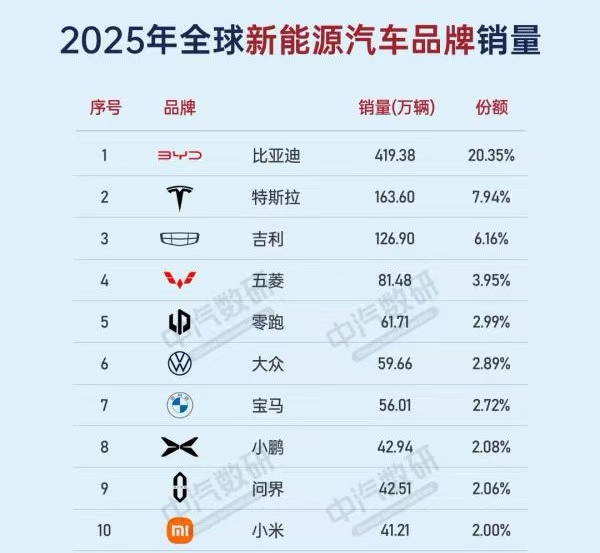
This list of the top ten global new energy vehicle brands by sales volume in 2025 clearly shows that the global electric vehicle landscape has been completely reshaped. Chinese domestic brands have fully taken the dominant position in the market, while traditional overseas car manufacturers have lagged behind in their transformation process. The industry's technology, market, and competitive logic have undergone fundamental changes. By analyzing the data, four core development trends can be identified.
The core data of the ranking is highly persuasive: Among the top ten positions, Chinese brands hold 7 spots, namely BYD, Geely, Wuling, Li Auto, Xiao Peng, Yawei, and Xiaomi. Tesla, Volkswagen, and BMW are the only overseas brands that made it to the list. BYD leads the pack with 4.1938 million units sold and a global share of 20.35%, leaving no other brand behind. Geely and Wuling follow closely with 1.2690 million and 0.8148 million units respectively. Li Auto, Xiao Peng, Yawei, and Xiaomi have steadily climbed to the top ten, covering the entire price range from affordable commuting to high-end intelligence. In contrast, the European, American, Japanese, and Korean automakers only maintain the second position for Tesla. The sales of Volkswagen and BMW are less than 600,000 units, leaving a huge gap compared to the leading Chinese brands. Traditional giants such as Toyota, Mercedes-Benz, and Hyundai have failed to make it into the top ten, and their efforts in electric vehicle transformation have been weak.
The first major trend: The core production capacity and supply chain of the global new energy industry have been completely shifted to China, and local brands have achieved a dominant advantage across all sectors. China has the most complete battery power, vehicle manufacturing, and intelligent cabin industrial chains in the world, with product matrices covering all consumption levels. Wuling has deeply focused on the micro transportation market and used high-performance and cost-effective models to open up the global lower-income market; BYD relies on the DM-i hybrid and pure electric dual-track approach, taking into account both household long-distance and urban commuting needs; Xiongpeng, Yebai, and Xiaomi focus on the high-end intelligent sector, relying on self-developed intelligent driving and in-vehicle systems to create differentiated competitiveness. The complete industrial chain brings scale cost advantages, and domestic automakers are accelerating overseas factory construction, exporting to Europe, Southeast Asia, and Latin America, continuously expanding global market share. Overseas automakers cannot replicate this complete industrial system in the short term.
Secondly, the exclusive brand benefits of purely foreign-owned new energy companies have waned, and traditional fuel giants have encountered bottlenecks in their electric transformation. Tesla once monopolized the leading position in global new energy, but now its market share is only 7.94%, relying solely on the Model 3 and Model Y models to drive growth. The shortcomings of a single product line and the slowdown in intelligent iteration have continued to be exposed. German luxury car manufacturers like Volkswagen and BMW still rely on the modification of fuel vehicle platforms for their electric products, lagging behind Chinese brands in software and autonomous driving capabilities, and lacking core appeal. Their market growth is also weak. Japanese and Korean automakers have a slower transformation pace, favoring hybrid power over pure electric, which is out of step with the global mainstream trend and directly fails to make it into the top ten list. The advantages of traditional automakers in the fuel era are rapidly disappearing.
Thirdly, the technological routes have become diversified, with hybrid, range-extended, and pure electric models all available to cater to different markets worldwide. BYD, Geely, and Wanxiang have addressed the issue of insufficient charging infrastructure in overseas markets by relying on plug-in hybrids and range-extended vehicles, and have received a large number of orders in Europe, Southeast Asia, and Central Asia. Wuling, Xiaopeng, and Zhongle focus on pure electric models, which are suitable for short-distance urban travel needs. The simultaneous promotion of these two technological routes is the key for Chinese brands to cover diverse global demands. However, most overseas automakers stick to pure electric routes and lack hybrid products suitable for developing countries, resulting in limited market coverage.
Fourth, intelligence has become the core of the competition in the second half, and new forces have quickly made rapid leaps. Among the rankings, Xiaomi, as a new entrant brand, ranked tenth in the first year with 412,100 units sold; Xiongpei and Yebai have formed core selling points through high-level intelligent driving and HarmonyOS cabin systems. Currently, when consumers choose new energy vehicles, they no longer only focus on range and batteries; intelligent interaction, automatic assistance driving, and vehicle system ecosystem have become the core decision-making factors. Chinese automakers generally self-develop intelligent software and hardware, and their iteration speed far exceeds that of overseas automakers. The gap in intelligence will continue to widen the market share gap.
Overall, the global automotive industry's trend towards electrification is irreversible, and the market dominance has shifted from Europe, America, Japan and South Korea to China. In the future, industry competition will no longer be limited to hardware manufacturing; overseas local operations, low-carbon battery technology, and full-stack self-developed intelligent systems will become new competitive barriers. If traditional overseas automakers fail to accelerate their electrification and intelligence transformation, their market share will continue to be eroded by Chinese domestic brands; while domestic automakers aiming to consolidate their advantages need to continue to deepen their overseas operations, improve the global supply chain, continuously maintain the speed of technological iteration, and firmly grasp the leading position in the global development of the new energy industry.
Leave A Reply

Please Give Us A Message